
Paddle Board Size Guide: Length, Width and Volume by Weight and Use

Most adults learning to paddle are best on an all-round board about 3.2–3.35 m (10'6"–11') long, 81–86 cm (32"–34") wide and 15 cm (6") thick if it is inflatable. Go longer and narrower for touring, wider for yoga, and shorter and lighter for children. Whatever you choose, keep your own weight plus gear well under the board's listed capacity.
Board size is a trade-off between stability, glide and how easy the board is to carry. The charts below are starting points used by paddling instructors and board makers, not hard limits: a confident paddler can ride a narrower board than the chart suggests, while a nervous beginner on a windy lake will be happier on a wider one. Board lengths in Canada are almost always quoted in feet and inches, so both are shown.
Paddle board size chart by rider weight
Use your body weight as you'll be dressed on the water, plus anything you'll strap to the deck: a dry bag, a cooler bag or a small child sitting at the nose.
| Rider plus gear | All-round board | Touring board | Inflatable thickness |
|---|---|---|---|
| Under 45 kg (100 lb), most children | 2.4–2.9 m (8'–9'6"), 71–76 cm (28"–30") wide | Not usually needed | 10–12 cm (4"–4.75") |
| 45–70 kg (100–155 lb) | 3.05–3.2 m (10'–10'6"), 76–81 cm (30"–32") | 3.5–3.8 m (11'6"–12'6"), 71–76 cm (28"–30") | 15 cm (6") |
| 70–90 kg (155–200 lb) | 3.2–3.35 m (10'6"–11'), 81–84 cm (32"–33") | 3.8 m (12'6"), 76–81 cm (30"–32") | 15 cm (6") |
| 90–115 kg (200–250 lb) | 3.35–3.5 m (11'–11'6"), 84–89 cm (33"–35") | 3.8–4.27 m (12'6"–14'), 81–84 cm (32"–33") | 15 cm (6") |
| Over 115 kg (250 lb) | 3.5 m (11'6") or longer, 86–91 cm (34"–36") | 4.27 m (14'), 81 cm (32") or wider | 15 cm (6") |
Length: what changes as a board gets longer
Length mostly controls glide and tracking, meaning how far the board travels per stroke and how well it holds a straight line.
- Under 3 m (10'): turns quickly and is light to carry, which suits children, small adults, river play and surf. It slows down fast between strokes and wanders more in a crosswind.
- 3.05–3.5 m (10'–11'6"): the all-round range. A 10'6" board is the most common beginner length; an 11' board gives heavier riders a bit more glide and room for a passenger or gear.
- 3.8 m (12'6") and longer: touring and racing lengths. They are noticeably faster over a few kilometres and track well on big lakes, but take more effort to turn and need more space on the car roof and in the garage.
If you'll mostly paddle a small cottage lake for an hour at a time, the extra length of a touring board is rarely worth the handling. If you plan day trips along a shoreline, it is.
Width: stability versus speed
Width has the biggest effect on how stable a board feels when you first stand up. Around 81–84 cm (32"–33") is the sweet spot for most adults: steady enough for a first session, still easy to paddle in a straight line. Boards of 86–91 cm (34"–36") feel like a floating dock, which is why they are popular for yoga and for anglers who stand still for long periods, but you'll have to reach further out to keep your paddle close to the rail. Touring boards are often 71–81 cm (28"–32") wide because a narrower hull slips through the water with less drag.
Thickness and volume
Inflatable boards: 10 cm or 15 cm?
Most adult inflatable boards are 15 cm (6") thick. That depth gives the board enough stiffness at the recommended pressure so it doesn't sag in the middle under an adult. Boards around 10–12 cm (4"–4.75") thick sit closer to the water and feel more connected, which works for children and light adults, but they flex under heavier riders. Always inflate to the pressure printed near the valve; many inflatables call for around 12–15 PSI and some are rated higher, and an under-inflated board feels wobbly whatever its size.
Hard boards: volume in litres
Epoxy and other hard boards are usually rated by volume in litres. A common rule of thumb for flat-water paddling is a board volume of at least twice your body weight in kilograms when you're learning, then about 1.5 times as your balance improves. An 80 kg paddler would start with about 160 L or more. Surf-style boards are often far lower than this, which is why they feel tippy on flat water.
Choosing a size by how you'll paddle
| Use | Typical length | Typical width | What to look for |
|---|---|---|---|
| All-round, first board | 3.2–3.35 m (10'6"–11') | 81–84 cm (32"–33") | Rounded nose, full-length deck pad, three-fin or removable centre fin |
| Touring and day trips | 3.8–4.27 m (12'6"–14') | 71–81 cm (28"–32") | Pointed nose, front and rear bungee, single larger tracking fin |
| SUP yoga and fitness | 3.05–3.35 m (10'–11') | 84–91 cm (33"–36") | Wide, long deck pad with no grooves under your hands, anchor point |
| Children | 2.4–2.9 m (8'–9'6") | 71–76 cm (28"–30") | Light enough for the child to carry, smaller-diameter paddle shaft |
| Rivers and moving water | 2.9–3.2 m (9'6"–10'6") | 81–86 cm (32"–34") | Rugged construction, shorter fins, waist-mounted quick-release leash |
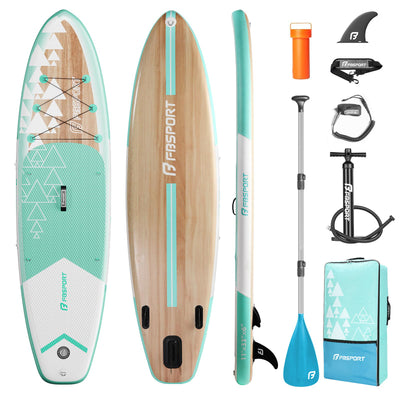
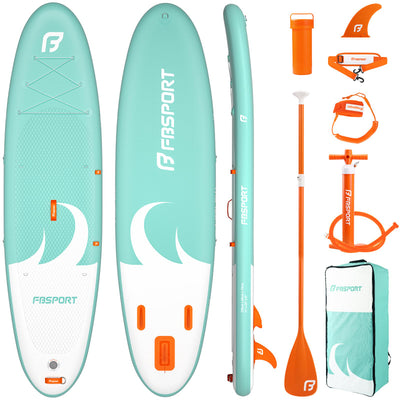
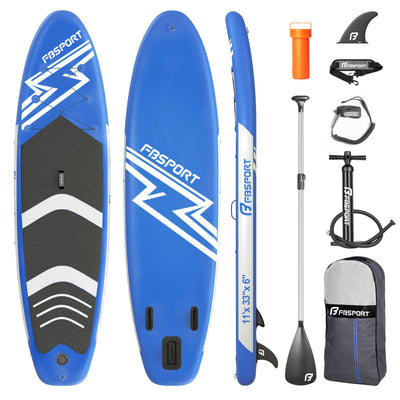
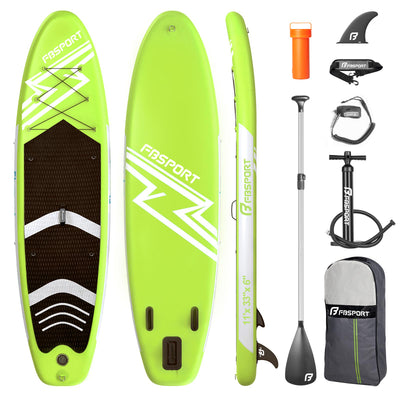
In our stand-up paddleboarding collection you'll see these categories in practice: niphean and FunWater inflatables at 10'6" x 33" x 6" are classic all-rounders, the niphean 12'6" is a touring length with a wider-than-usual 33" deck, and the FBSPORT 11' x 33" boards are marketed for both youth and adult riders, with a deck wide enough for yoga.
Inflatable vs hard paddle boards
| Inflatable | Hard (epoxy, composite, plastic) | |
|---|---|---|
| Storage and transport | Rolls into a backpack; fits a car trunk or a condo closet | Needs a roof rack and wall or ceiling storage |
| Setup time | About 5–15 minutes of pumping, less with an electric pump | None |
| Performance | Stable and forgiving; slightly less glide | Stiffer and faster; better in chop and for surfing |
| Durability | Shrugs off rocks and docks; watch for punctures from sharp edges | Dings and cracks need repair before the board goes back in the water |
| Comfort | Softer to kneel or fall on, which beginners and kids appreciate | Firm deck |
For most Canadian buyers who drive to a lake or carry a board to the cottage, an inflatable is the practical choice. A hard board makes more sense if you live on the water, have a rack and want the extra speed.
Reading the weight capacity on a board
The capacity printed on a listing (for example 204 kg (450 lb) on many 10'6" inflatables, or 249 kg (550 lb) on a 12'6" touring board) is the most the board will float, not the weight it paddles best with. Near that figure the board sits low, the tail drags and it becomes harder to balance. A useful habit is to compare the capacity with your total load and choose the size up if you're anywhere close, especially if you'll carry a passenger or a dog.
What Transport Canada requires on a paddleboard
Transport Canada treats a stand-up paddleboard as a human-powered vessel when you use it to travel on the water, for example a crossing, a shoreline trip or a loop around the bay. The requirements are set out in the Small Vessel Regulations and explained in plain language in the Safe Boating Guide (TP 511). What you must carry depends on one question: are you wearing your flotation device?
- If you wear a Canadian-approved PFD or lifejacket of the right size: you are only required to carry a sound-signalling device, such as a pealess whistle, plus a watertight flashlight if you paddle after sunset, before sunrise or in periods of low visibility.
- If the PFD is only on board (strapped under the bungees, for example): the full list in the Safe Boating Guide for sealed-hull craft applies, the same table that covers sit-on-top kayaks and paddleboats. For a board that means a buoyant heaving line at least 15 m (49'3") long as well as the sound-signalling device, navigation lights (a watertight flashlight) when it is dark or visibility is low, and a magnetic compass if you head out of sight of navigation marks. A heaving line is awkward to carry on a board, which is one more reason to wear the PFD.
A few more points from Transport Canada's guidance matter for paddlers. A board leash is not a substitute for a PFD. Transport Canada's page on choosing lifejackets and PFDs notes that inflatable PFDs are not permitted for anyone under 16 or weighing under 36.3 kg (80 lb), so children need inherently buoyant foam devices. The Safe Boating Guide adds that an inflatable has to be worn to count as approved, is not allowed for white-water paddling, and inflates more slowly when temperatures are near freezing, so a foam PFD is the better pick for spring and fall paddling. The Safe Boating Guide also recommends a quick-release leash worn at the waist on rivers and moving water, where an ankle leash can snag. The Lifesaving Society reports that nine in ten boaters who drowned were not wearing a lifejacket or PFD.
For label types, sizing and children's features, read our PFD vs lifejacket guide, and for the complete list by craft type see canoe, kayak and SUP safety equipment required in Canada. When you browse life jackets and PFDs, look for a paddling cut with large arm openings so the vest doesn't rub with every stroke. This is general information, not legal advice; the regulations take priority over any summary.
Gear that goes with the board
- Paddle: for all-round paddling, a length roughly 20–25 cm (8"–10") taller than you is a good starting point; adjustable aluminum or carbon paddles let the whole family share one. See paddles.
- Leash and fins: check your fin box type, usually a US box or a click-in system, before ordering a spare.
- Dry bag or deck cooler: keep your phone, keys and a layer dry under the front bungees. MORXPLOR and YVLEEN make insulated deck bags for exactly this; see also our dry bags.
- Carry and storage: a board bag protects a hard board in transit, and kayak, canoe and SUP racks handle the roof and the garage wall.
Canadian water stays cold well into June on many lakes, so dress for a swim, not for the air temperature. Transport Canada recommends that all paddlers take a learn-to-paddle safety course; Paddle Canada runs a Stand Up Paddleboard program that starts with a Basic SUP skills course in calm, sheltered water.
Frequently asked questions
What size paddle board do I need for my weight?
Most adults between about 70 and 90 kg (155–200 lb) do well on an all-round board 3.2–3.35 m (10'6"–11') long and 81–84 cm (32"–33") wide. Lighter paddlers can go shorter and narrower; heavier paddlers should look at 11'–11'6" and 84–89 cm (33"–35") wide. Add the weight of any gear, passenger or dog, and choose a board whose listed capacity is comfortably above that total.
Is a 10'6" or 11' paddle board better for beginners?
Both are good first boards. A 10'6" board is lighter, easier to carry and turns more readily, which suits paddlers up to about 80 kg and smaller cottage lakes. An 11' board glides a little further per stroke and has more room for gear or a child, so it suits heavier riders and people who plan longer outings. Width affects first-day stability more than this extra 15 cm (6") of length.
Do I need a lifejacket on a paddle board in Canada?
Yes. When a paddleboard is used to travel on the water, Transport Canada counts it as a human-powered vessel and requires a Canadian-approved PFD or lifejacket of the right size for each person on board. If you wear it, you only need to add a sound-signalling device such as a whistle and, after dark or in low visibility, a watertight flashlight. If it is only stowed on the board, the full sealed-hull list applies, including a buoyant heaving line at least 15 m long. A leash does not replace a PFD.
Is a 6-inch inflatable SUP better than a 4-inch one?
For adults, usually yes. A 15 cm (6") board stays stiffer at its recommended pressure, so it doesn't sag in the middle under an adult's weight and feels more stable. Boards around 10–12 cm (4"–4.75") thick sit closer to the water and suit children and lighter adults who prefer that connected feel. Whatever the thickness, inflate to the pressure printed near the valve.
Can two people or a dog ride on one paddle board?
It can be done on a long, wide all-round board, but the combined weight must stay well under the board's listed capacity, and the board will feel less stable than with one rider. Each person on board needs their own properly sized, Canadian-approved PFD under Transport Canada rules. With a dog, start in shallow, calm water close to shore and let the dog settle on the front of the deck pad.