
Kids' Ice Skate Size Guide: Youth, Junior and Senior Sizes Explained

Kids' ice skates should fit the foot your child has today, not the one you expect next winter. Measure both feet in centimetres, try skates on with one thin pair of skate socks, and check that the toes just brush the front while one finger fits behind the heel. Hockey skates usually run about a half size smaller than shoes; adjustable skates are labelled with shoe-size ranges.
This guide covers how skate sizes relate to shoe sizes, what Youth, Junior and Senior labels mean, how much growing room is safe, and the signs that it's time to move up a size. For the full hockey fit routine, including heat moulding and lacing, see our hockey skate sizing guide.
Why skate size and shoe size don't line up
A skate boot is built to hold the foot far more firmly than a running shoe, and every brand uses its own last and size run. Hockey Canada's Safety Requires Teamwork equipment guide says hockey skates usually fit a half size smaller than street shoes, while its older Hockey Canada 101 parent guide puts it at one to one and a half sizes. The two figures differ, which tells you something useful: shoe size is only a place to start.
Figure skates are less predictable again. Each figure skate maker publishes its own chart, and the gap between shoe size and skate size changes from brand to brand, so the chart for the exact model matters more than any general rule. Adjustable kids' skates are the simplest case, because they are sold by the shoe-size range they cover, such as 10C–13C or 1–4.
How to measure your child's foot at home
A tape measure and a sheet of paper give you a better starting point than the size printed inside last year's boots.
- Measure late in the day, when feet are at their largest.
- Have your child stand with their full weight on the foot, heel against a wall, wearing the thin socks they'll skate in.
- Mark the tip of the longest toe (it isn't always the big toe), then measure from the wall to the mark in centimetres.
- Measure both feet. One is often a few millimetres longer, and that's the one to size for.
- Compare the length with the brand's chart for that skate, then confirm with a try-on.
Youth, Junior, Intermediate and Senior: what the labels mean
Hockey skates are grouped into size bands. The boundaries shift slightly between brands, but the pattern below is what you'll see on most boxes and listings.
| Label | Typical size range | Who usually wears it | What to watch |
|---|---|---|---|
| Youth (Y) | Around Y6 to Y13.5 | Preschoolers and younger school-age children | The "Y" matters: Y13 and Y13.5 sit just below Junior 1, not up near an adult 13 |
| Junior (Jr) | Around 1 to 5.5 | Older children and pre-teens | Boots get stiffer here; a light child may not flex a stiff Junior boot |
| Intermediate (Int) | Around 4 to 6.5, where offered | Pre-teens and young teens between Junior and Senior | Not every brand has this band; volume and stiffness sit between Jr and Sr |
| Senior (Sr) | Around 6 or 7 and up, depending on brand | Teens and adults | Heavier, stiffer boots built for adult body weight |
Figure skates use different wording. You'll usually see children's sizes (often marked with a C, like shoes), then girls' or "misses" sizes, then women's and men's sizes. Women's and men's scales are not the same number for the same foot: listings often show both, for example a women's 8 alongside a men's 6.5. Check which scale a size refers to before you compare it with your child's shoes.
Sizing by age: a rough starting point only
Age is a weak predictor of skate size. Two eight-year-olds can easily be three sizes apart, and a growth spurt can move a child from one band to the next in a single season. Use age to narrow the search, then let the tape measure decide. Adjustable skates show this best, because each pair spans about four sizes:
| Adjustable size | Typical range on the label | Common stage |
|---|---|---|
| Small | Around 10C–13C | Many preschool and kindergarten skaters |
| Medium | Around 1–4 (some brands 2–5) | Many children in the early and middle grades |
| Large | Around 4–8, often overlapping women's sizes | Older children and pre-teens |
| X-Large | Around 8–10 or more | Teens and smaller adults |
Ranges differ by brand, so read the label on the exact pair. You'll find both fixed-size and adjustable pairs in our kids' ice skates.
Growing room: how much is too much
It's tempting to buy a size or two up and fill the gap with thick socks. Hockey Canada is blunt about it: never buy skates too big to grow into, because it can seriously hold back proper skating development. A boot that's too long lets the heel lift, the ankle wobbles, and the child ends up skating on the inside edges of the blades. Extra socks make it worse by bunching, causing blisters and cold feet.
If growth is the worry, adjustable skates are the honest way to handle it. Set the toe section to the size your child needs now, not the largest setting, and move it one click at a time as they grow. Parachute, the Canadian injury prevention charity, advises on its ice skating safety page that skates should give firm ankle support and fit snugly, and that softer boots suit children better than hard, unyielding ones while their feet are still growing.
Hockey and figure skates fit differently
Both should feel snug, but the details change with the boot.
- Hockey skates sit lower on the ankle and have a rounded blade with no toe pick. Toes should lightly brush the toe cap when standing and pull back slightly when the knees bend. Browse hockey skates if your child is heading to minor hockey or shinny.
- Figure skates have a taller boot laced over hooks at the ankle and a blade with a toothed toe pick at the front. The heel needs to sit firmly in the heel pocket, because any lift becomes a wobble on the longer blade. See our figure skates for children's and adult models.
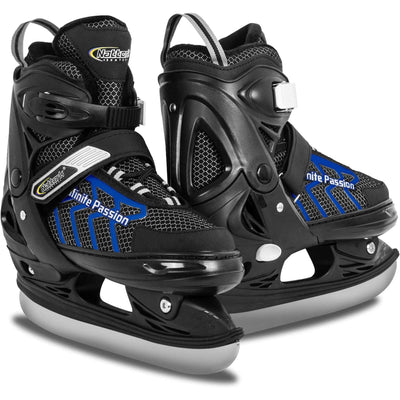
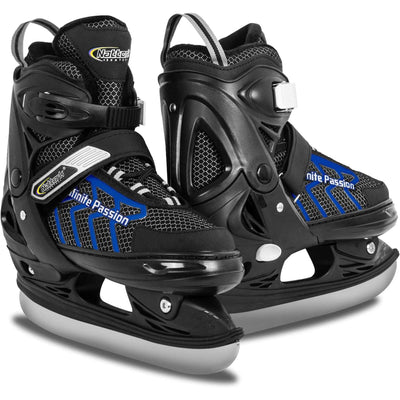
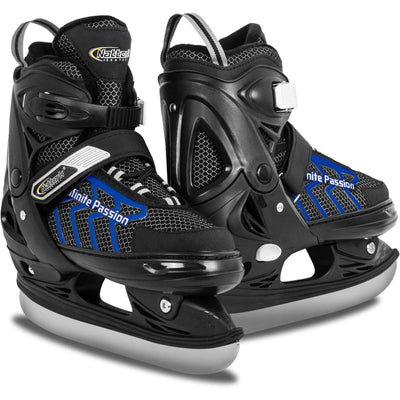
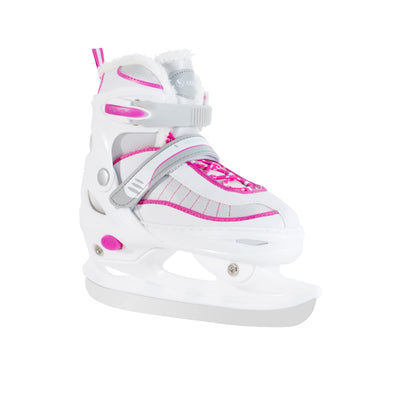
- Recreational and adjustable skates fall between the two: padded, warm and forgiving, which suits public skating and outdoor rinks. The wider range is in ice skates.
Trying skates on: socks first, then four checks
The sock choice changes the fit more than most parents expect. Hockey Canada recommends a single pair of socks, the same ones worn for skating, pulled smooth with no wrinkles. A thin skate sock or snug synthetic sock works; a thick wool hiking sock usually doesn't.
- Heel back. Loosen the laces, slide the foot in and tap the heel on the floor so it settles into the heel pocket.
- Finger test. Before lacing, slide the foot forward until the toes touch the front, then slip one finger behind the heel. One finger is right; two means the skate is too long.
- Lace and bend. Lace snugly, then have your child bend their knees. The heel should stay down and the toes shouldn't be jammed or curled.
- Walk test. With guards on, walk for 10 to 15 minutes, then check the feet for red spots or pressure points.
Younger children often can't describe how a boot feels. Press on the toe cap with your thumb to feel where the toes are, and watch their ankles as they stand: ankles folding inward or outward on a new skate suggest the boot is too big or too soft for them. Keep a pair of guards from hockey skate accessories handy for indoor walk tests so the blades stay sharp.
When to resize
Children rarely announce that their skates are too small; they just stop wanting to skate. Check the fit at the start of each season and again around midwinter for fast growers. Move up a size when you notice any of these:
- The finger test leaves no room at all behind the heel.
- Toes are curled or pressed hard into the toe cap when standing.
- Red marks or sore spots on the toes after a skate.
- Your child is suddenly reluctant to lace up, or complains of cold or numb feet that weren't a problem before.
- An adjustable skate is already on its largest setting.
Hand-me-down skates deserve a quick inspection too. Hockey Canada lists checks for sharpness, bent blades, loose rivets and cracked blade holders, and says skates with a cracked toe cap shouldn't be worn.
Before the first skate
Have the blades checked: dull blades make stopping and turning harder, which frustrates beginners. Pair the skates with a CSA-approved helmet, which Parachute recommends for skating because these helmets are tested for falls on ice; if your child is joining a CanSkate club, note that Skate Canada makes a CSA-approved hockey helmet compulsory for every skater through Stage 5 (see its helmet rules for clubs). If your child is starting minor hockey, work through our kids hockey equipment checklist, and before any pond or lake skating, read our ice thickness safety guide.
Frequently asked questions
Should kids' ice skates be bigger than their shoes?
No. Hockey skates usually fit about a half size smaller than street shoes, and figure skate sizing depends on the brand's own chart. Buying bigger to allow for growth makes the heel lift and the ankles wobble, which Hockey Canada says can hold back skating development. Measure the foot in centimetres, compare it with the brand chart and confirm the fit with a finger test behind the heel.
What is the difference between Youth and Junior skate sizes?
Youth sizes, marked with a Y, cover small feet, roughly Y6 to Y13.5. Junior sizes start again at 1 and usually run to about 5.5, so a Junior 1 is larger than a Y13. Some brands add an Intermediate band between Junior and Senior. Exact boundaries vary between brands, so always read the size label on the specific skate.
How much growing room should kids' skates have?
Very little. With the laces loose and the toes touching the front, you should fit one finger behind the heel, not two. That small gap closes once the heel is pushed back and the skate is laced. If you want skates to last through growth, adjustable skates are the better route: set them to today's size and extend them one step at a time.
What socks should kids wear with ice skates?
One thin pair of skate socks or snug synthetic socks, pulled smooth with no wrinkles. Hockey Canada recommends a single pair of socks, the same ones worn for skating, when fitting skates. Thick or doubled socks bunch up, cause blisters, and can actually make feet colder by squeezing circulation and trapping sweat inside the boot.
How often should I check my child's skate size?
At the start of every season and again around midwinter, since many children grow noticeably within a single winter. Size up when the finger test leaves no room behind the heel, the toes are curled or pressed hard against the toe cap, or your child comes off the ice with sore toes. An adjustable skate on its largest setting also needs replacing.